Food Truck Hood Cleaning in North York
North York Hood Cleaning is the food truck cleaning service for the compact hood, short duct run and roof fan built into a mobile kitchen. The crew degreases the assembly where the truck is parked or at its commissary, captures wastewater and runoff instead of letting it reach the ground or a storm drain, and works carefully around the onboard propane and generator lines. Pricing is quoted per truck after a short inspection, and every visit ends with a signed certificate an event organiser or licensing office can hold on file.
Food truck hood cleaning in North York: a small hood carrying a full-heat line
A food truck packs a griddle, a fryer or a wok burner into a few feet of counter, so its hood, duct and roof fan are all built small. The trade-off is that a compact system fouls faster: the same grease a restaurant spreads across a ten-foot canopy lands on a hood barely a third that size.
The truck hood sits directly over the cook line, usually under a low ceiling with almost no clearance for a crew to work standing up. The duct run is short, often no more than the distance from the hood collar straight up through the roof, which means less horizontal travel but a tighter bend at the roofline. The roof fan discharges close to the ground when the truck is parked, so where the exhaust vents matters at a festival or a plaza lot.
Cleaning where the truck is parked, or at its commissary
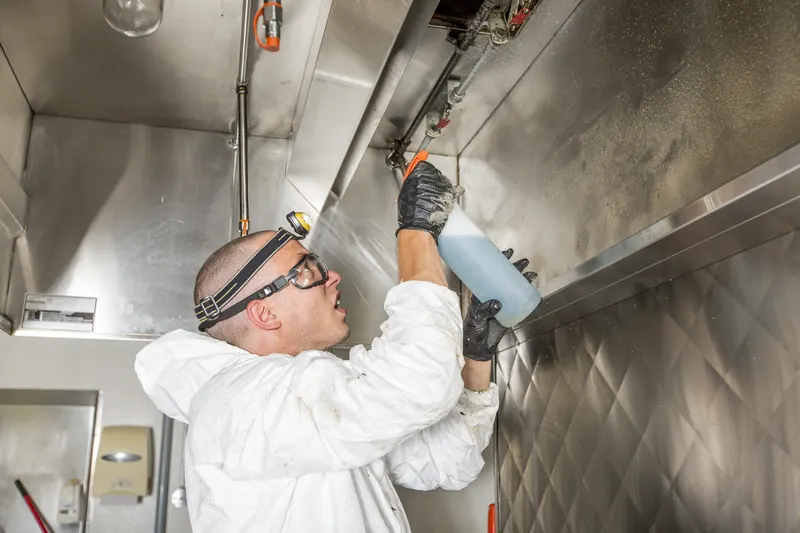
Most trucks in North York get cleaned two ways. The first is on location, wherever the truck is parked between events, with the hood, duct collar and fan reached from a short ladder against the vehicle. The second is at the truck's commissary kitchen, the licensed base where the truck restocks and often parks overnight, which gives the crew full access without blocking a street or lot during service hours.
Wastewater and runoff. Degreaser and rinse water are captured rather than allowed to run off the truck onto pavement or toward a storm drain, using containment mats and a wet-vac recovery at the spray point. This matters more for a truck than a fixed kitchen, since a truck often sits on public pavement or an open lot with no floor drain underneath it.
Propane and generator safety. A truck's propane tanks and, where fitted, its generator sit close to the cook line and the hood being cleaned. The crew shuts down and isolates both before any degreaser or spray touches the hood, and confirms the tank valves and generator are off for the full length of the visit.
Food truck vs restaurant hood cleaning in North York
The equipment is smaller on a truck. The logistics around it are what actually changes the job.
| Food truck vs restaurant: what differs | Food truck | Restaurant |
|---|---|---|
| Hood and duct size | Small hood, short duct, tight clearance to work in. | Ten-foot canopy or more, duct run above the ceiling to the roof. |
| Where the work happens | Wherever the truck is parked, or at the commissary. | A fixed address, usually overnight or between services. |
| Runoff handling | Captured with mats and a wet-vac, since there is often no floor drain. | Drains into the kitchen's own floor drain system. |
| Fuel and power on site | Onboard propane and, often, a generator, both isolated before cleaning. | Building gas and electrical, isolated at the kitchen's own shutoffs. |
| Pricing | Quoted per truck after inspection. | From $585 per visit for a single hood up to ten feet. |
How often a truck needs cleaning through a North York festival season
A truck working a full festival season runs more service hours in a summer weekend than many restaurant kitchens run in a week, so the hood loads fast even though it is small. A truck that books multiple events a month is checked and cleaned more often than one that runs a single weekly stop, and the right interval for a given truck is set at the free walk-through against how many events, and what kind of line, it runs.
A truck cooking on a wok burner or an open flat-top loads its hood faster than one running mostly a fryer, the same pattern seen on a fixed cook line, just compressed into a much smaller hood.
The certificate for event organisers and licensing
Festival and market organisers, and municipal licensing offices, often want proof a food truck's exhaust system has been serviced before it sets up for the day. North York Hood Cleaning issues a signed health and safety certificate referencing the published NFPA 96 standard after every visit, dated and ready to attach to a vendor application or hand to an organiser on setup morning, along with proof of WSIB coverage and liability insurance.
How much does food truck hood cleaning cost in North York in 2026?
Food truck hood cleaning is quoted per truck after inspection, since hood size, appliance type and access at the parking or commissary location vary more than they do in a fixed kitchen. For comparison, restaurant hood cleaning runs from $585 per visit for a single-hood kitchen up to ten feet and from $995 per visit for two to four canopies.
What moves a truck quote: hood and duct size, how greasy the line runs (wok and open-flame trucks load faster than a fryer-only setup), and whether the visit happens at a parking spot with no floor drain or at a commissary with full access. The written quote comes back within 24 hours of the inspection.
Next step: call 647-797-9137 or request a written quote. Say the truck's main appliance and where it is usually parked or based. Restaurant hood cleaning detail is on the hood cleaning services page.
Food truck hood cleaning in North York: frequently asked questions
How much does food truck hood cleaning cost in North York?
Food truck hood cleaning is quoted per truck after inspection, because hood size and access vary more between trucks than between fixed restaurant kitchens. A restaurant hood, for comparison, runs from $585 per visit.
Can a food truck be cleaned while it is parked at a lot or festival site?
A food truck can be cleaned wherever it is parked, using containment mats and a wet-vac to capture wastewater and runoff since there is usually no floor drain underneath it. Cleaning at the commissary kitchen is the other option.
Is it safe to clean a hood with the truck's propane and generator on board?
The propane tanks and generator are shut down and isolated for the full length of the visit before any degreaser touches the hood, and confirmed off before the crew starts.
How often should a food truck get its hood cleaned during festival season?
A truck running multiple events a month needs cleaning more often than one with a single weekly stop, since service hours drive the load more than weeks on the calendar. The right interval is set at the free walk-through.
Does a food truck get a certificate an event organiser can see?
Every food truck visit ends with a signed health and safety certificate referencing the published NFPA 96 standard, dated and ready to attach to a vendor application or show an organiser on setup morning.