NFPA 96: the standard behind commercial kitchen exhaust cleaning in North York, 2026
NFPA 96 is the Standard for Ventilation Control and Fire Protection of Commercial Cooking Operations, published by the National Fire Protection Association and revised periodically. It covers the full grease path in a commercial kitchen (hood, filters, plenum, duct, rooftop fan and suppression system), sets 0.078 inches as the grease depth at which a surface must be cleaned, publishes inspection intervals by type and volume of cooking, and describes the records an operator keeps. In North York it reaches a kitchen through the Ontario Fire Code, which references NFPA 96. This guide references the published standard; North York Hood Cleaning is not affiliated with NFPA.
Last updated September 2026
NFPA 96 standards: what the document is and what it covers
NFPA 96 is a technical standard, not a statute, enforceable in Ontario because the Ontario Fire Code references it. Its cleaning provisions rest on three ideas.
Grease is a fire load. Deposit inside the exhaust path is fuel above an open flame, so the standard names a measurable depth at which a surface needs cleaning: 0.078 inches, from the plenum behind the filters to the inside of the fan housing.
Cooking sets the inspection, inspection sets the cleaning. The standard publishes how often a system is inspected for grease build-up by type and volume of cooking, and cleaning follows when the inspection finds deposit at or over the limit. A wok, charbroil or Korean barbecue line moves through that interval faster.
Records are part of compliance. Dated records of each inspection and cleaning, stating what was cleaned and by whom.
Cooking volume vs inspection interval: NFPA 96 requirements by type of cooking
NFPA 96 requirements set four inspection intervals, and the interval follows the type and volume of cooking, not the size of the kitchen.
| Cooking volume vs inspection interval | Cooking operation named in NFPA 96 | What that looks like in North York |
|---|---|---|
| Monthly | Solid-fuel cooking | A wood-fired pizza oven or a smokehouse line on the Yonge corridor. |
| Quarterly | High-volume cooking, including 24-hour operation, charbroiling and wok cooking | A wok range in an Indo-Chinese kitchen or a Korean barbecue table-grill line in Willowdale. |
| Semi-annually | Moderate-volume cooking | A single-shift kitchen near Don Mills or Bayview Village. |
| Annually | Low-volume cooking, including churches, day camps and seasonal businesses | A church hall kitchen or a seasonal camp kitchen near Downsview Park. |
Source: the published NFPA 96 standard. The intervals are a floor, not a ceiling.
What are grease-laden vapours?
Grease-laden vapours are the airborne mix of vaporised fat, oil, water and smoke that rises off cooking appliances and condenses back into grease on every cooler surface inside the exhaust path.
The phrase is the trigger for the whole standard. NFPA 96 applies to equipment that produces grease-laden vapours, which is why a fryer, a wok burner or a charbroiler brings a kitchen inside the standard while a steam table alone does not. Each drop in temperature through the filters, plenum, duct and fan leaves a layer behind, and that layer is what the 0.078 inch measurement reads. A wok or tandoor line throws vapour into the air faster than a pan does, loading a system in weeks.
How the Ontario Fire Code references NFPA 96, and what Toronto Fire Services looks for
The Ontario Fire Code is the provincial regulation for fire safety, and it references NFPA 96 as the standard that commercial cooking exhaust systems are inspected and cleaned against. North York has been part of the City of Toronto since amalgamation in 1998, so Toronto Fire Services fire prevention inspectors enforce the Fire Code here.
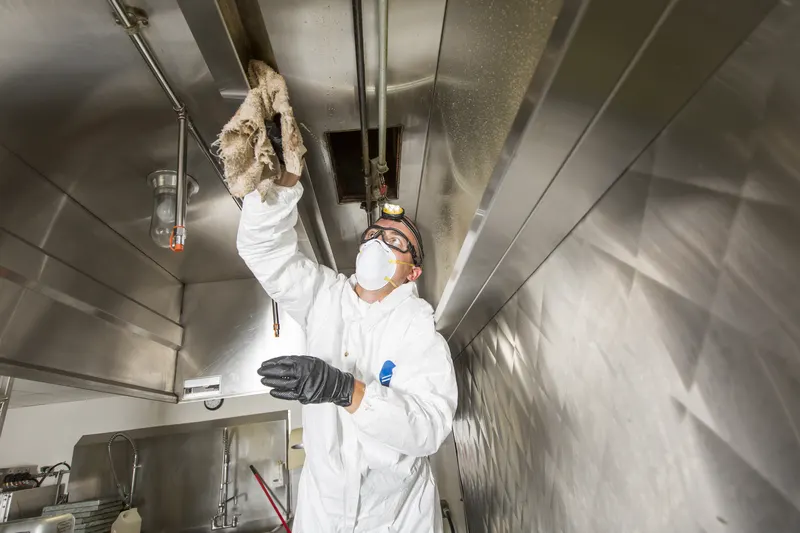
The Fire Code carries the duty to inspect, clean and keep records; NFPA 96 is the technical document it points to for the detail. An inspection tends to run in the same order: the officer reads the most recent cleaning record (one that lists the hood alone invites the question of whether the duct and fan were opened), checks the plenum behind the filters, confirms duct access panels can be reached, and asks whether the rooftop fan opens.
Thornhill kitchens west of Yonge Street sit in the City of Vaughan, where Vaughan Fire and Rescue Service is the fire authority and York Region Public Health inspects food premises; Yonge Street is the municipal line. Fire services enforce, and an officer reads the certificate on file as evidence, not proof.
Certified hood cleaning company Ontario: what exists and what to look for
NFPA 96 certification for a hood cleaning company does not exist. NFPA writes and publishes standards. It does not certify contractors or endorse companies, so no company in North York holds a certification from NFPA.
The phrase "certified hood cleaning company" is searched many times a year in Ontario, and no body issues that credential: not NFPA, not the Ontario Fire Code, not Toronto Fire Services. What exists is proof: a signed health and safety certificate referencing the published standard, before-and-after photographs of every cleaned surface, and proof of WSIB coverage and liability insurance before work starts.
What the certificate asserts. That named sections of one system (hood, filters, plenum, horizontal duct, riser, fan) were cleaned on one date, the grease depth found, and a signature stating the work references the published standard, not affiliation with NFPA.
What it does not assert. It is not a fire inspection, and it covers only the sections it names, so a certificate that says "hood" leaves the duct and fan unaccounted for. It is a record of work, not a credential. Each section's scope is on the hood cleaning services, kitchen exhaust cleaning and exhaust fan repair pages.
DineSafe, Toronto Public Health and the fire file
Toronto Public Health inspects food premises in North York for food safety and posts results through DineSafe, including at the restaurant entrance, and that inspection is separate from the fire file.
DineSafe covers food handling and sanitation. The exhaust system is a fire matter under the Ontario Fire Code and sits with Toronto Fire Services, not the health inspector. A clean DineSafe posting says nothing about the grease depth in the duct.
Who is responsible for NFPA 96 compliance, the restaurant or the landlord?
Responsibility for NFPA 96 compliance sits with whoever controls the cooking operation, which in most North York leases is the restaurant tenant, while the lease decides who answers for the roof and structure.
The Ontario Fire Code places its duties on the owner, a word broad enough to reach a tenant in control of the kitchen. A landlord whose tenant lets the duct load up can find a fire prevention order landing on the building too. In a food-court unit or a tower-base restaurant, the party that cooks keeps the record. Paperwork needs by segment are on the who we serve page.
Where to find NFPA 96 hood cleaning near me in North York
North York Hood Cleaning reads kitchens across North York and Thornhill west of Yonge Street against the published standard during a free walk-through. Coverage detail is on the areas served page.
Next step: call 647-797-9137 or request a written quote. Bring the last certificate if there is one.
NFPA 96 in North York: frequently asked questions
How often does NFPA 96 require hood cleaning?
NFPA 96 publishes four intervals: monthly for solid-fuel cooking, quarterly for high-volume cooking including charbroiling, wok cooking and 24-hour operation, semi-annually for moderate volume, and annually for low volume such as churches and day camps.
Does NFPA 96 apply to a church or camp kitchen that cooks a few times a month?
NFPA 96 applies to every commercial cooking operation that produces grease-laden vapours, however seldom it runs. Churches and seasonal businesses carry an annual interval, the longest in the standard, rather than an exemption.
Is NFPA 96 the law in Ontario, or is it a Canada-wide standard?
NFPA 96 is a standard, and the Ontario Fire Code is the law that references it for commercial cooking exhaust. Other Canadian provinces reference the same standard in their own fire codes.
Is a hood cleaning certificate the same as passing a fire inspection?
A hood cleaning certificate is the contractor's record of what was cleaned and when. A fire inspection is Toronto Fire Services' check of the whole premises, which reads the certificate as evidence, not a pass.
Is there such a thing as a certified hood cleaning company in Ontario?
No credential called NFPA 96 certification exists. NFPA publishes the standard and certifies no one. A kitchen can ask instead for a signed certificate referencing the standard and proof of WSIB coverage and liability insurance.