Kitchen Exhaust Cleaning in North York
North York Hood Cleaning is the kitchen exhaust duct cleaning service that covers the grease path between the hood collar and the rooftop fan: the horizontal run above the ceiling, the riser that climbs a building, and the access panels that let a crew reach each section. Every panel gets opened, every section gets scraped to bare metal, and the NFPA 96 grease limit of 0.078 inches gets checked along the whole path, not just at the hood. A restaurant at the base of a condo or office tower on the Yonge corridor often has the longest riser on the block, and a food-court unit often shares one run with the kitchen next door. Both get named on the certificate.
Commercial kitchen exhaust cleaning in North York: the horizontal run, the riser and the access panels
The horizontal run leaves the duct collar on top of the hood and travels above the ceiling to the shaft. Grease drops onto the duct floor in the first few feet and packs into the outer wall of every elbow, and a wok or charbroil line loads that first stretch fast.
The riser is the vertical leg that climbs the building to the roof. Vapour condenses on its walls and slides down to the turn at the bottom, so a riser checked only from the roof can look acceptable while its base holds a pool nobody has measured. A restaurant on the ground floor of a Yonge Street tower can be running a riser several storeys tall.
Access panels are gasketed, removable openings in the duct wall. A run with no panels is a run nobody has cleaned, and the walk-through marks each spot where one is missing. Canopy work is on the hood cleaning services page, the fan on the exhaust fan repair page.
Hood-only vs full-system kitchen exhaust cleaning in North York
A Toronto Fire Services inspector reads the difference between the two records in seconds.
| Section of the system | Hood-only vs full-system: what hood-only covers | What full-system covers |
|---|---|---|
| Duct collar | Wiped as far as an arm reaches. | Scraped through the first panel and measured. |
| Horizontal run and elbows | Not opened. Not on the certificate. | Every panel opened, each elbow scraped, a dated photograph inside each one. |
| Base of the riser | Not reached. | The pooled layer at the turn scraped out and measured. |
| Fan inlet | Not reached. | Cleaned from the roof and measured. |
| The certificate | Names the hood. | Names each section cleaned and each section not reached, with the reason. |
What the certificate asserts, and what it does not, is on the NFPA 96 page.
Best kitchen exhaust duct cleaning in North York for a tower base or a food-court unit
North York Hood Cleaning documents each branch to the junction and quotes the shared riser to building management.
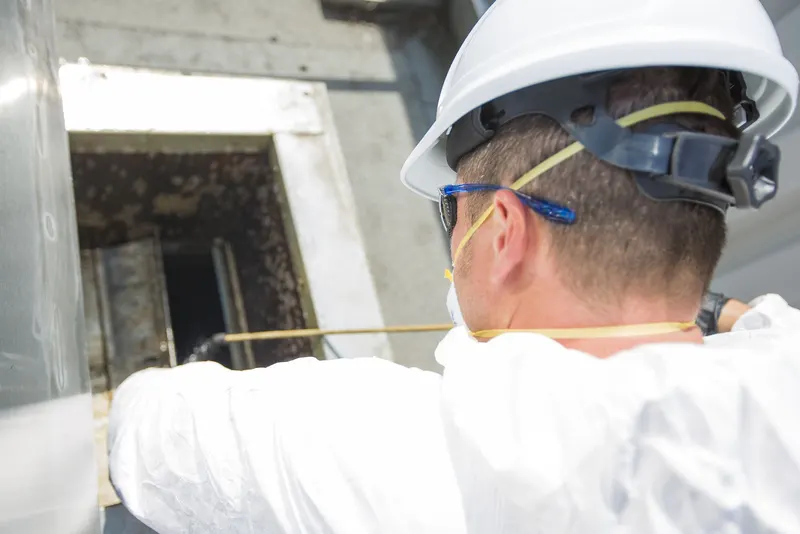
A restaurant at the base of a condo or office tower along the Yonge corridor usually runs its duct up through a shaft shared with the building's mechanical systems, and the riser can climb several floors before it reaches the roof. A food-court unit at Yorkdale, Fairview Mall or Bayview Village Shopping Centre often vents into one shaft with the cooking lines on either side, on landlord access hours that push the work overnight or between services.
The split gets written down before the crew arrives. Each unit owns its canopy, plenum and branch duct to the junction; the riser and the fan belong to the building. The tenant's certificate states where the branch ends, and a separate riser quote goes to property management with proof of WSIB coverage and liability insurance.
The 0.078 inch limit along the whole path, from collar to fan inlet
North York Hood Cleaning takes the depth reading at four points on a full-system visit: the collar, where the first drop-out lands; the outer wall of each elbow; the base of the riser, where the walls above drain; and the fan inlet, the last surface before discharge and the one a hood-only report never mentions.
A section without a panel gets no reading and is never listed as cleaned. The certificate lists it as not accessible and names the panel that would open it.
Hood vent cleaning and hood filter access along the duct run
Hood vent cleaning of the canopy sets the pace for the duct behind it, because a loaded filter bank feeds the collar faster.
The filters and the canopy interior are a separate scope, covered in full on the hood filters page. What matters here is the handoff: a filter bank that has gone missing a slot or two lets more grease past into the plenum and the first stretch of duct, so the walk-through checks the filter fit at the same time it checks the collar.
Creosote in the duct: wood-fired ovens and smokers in North York
Grease from a gas line is one deposit. Wood smoke adds a second: its tar condenses as creosote on every duct surface cooler than the firebox, sets into a hard glaze and takes the grease into it. The result ignites at a lower temperature than grease alone and shrugs off fryer-duct degreaser.
The wood-fired pizza ovens and smokehouse kitchens serving North York fall under the monthly interval NFPA 96 publishes for solid-fuel cooking for this reason. A creosote-lined duct comes clean by hand scraping, and solid-fuel duct work is quoted per job after inspection.
Where to find kitchen exhaust cleaning services near me in North York
North York Hood Cleaning traces duct runs across North York (Willowdale, Downsview, Don Mills, Bayview Village, York Mills, Lansing, Newtonbrook, Bathurst Manor and the Yonge corridor from Highway 401 to Steeles Avenue) and Thornhill west of Yonge Street.
Long risers cluster in the towers along Yonge Street through Willowdale and North York Centre. Shared runs are common in the plaza and mall units near Sheppard and Don Mills. Community detail is on the areas served page.
How much does kitchen exhaust duct cleaning cost in North York in 2026?
Kitchen exhaust cleaning in North York costs from $585 per visit for a single-hood kitchen up to ten feet and from $995 per visit for a multi-hood kitchen of two to four canopies. Food-court, hospital, campus, care-home and shared-riser systems are quoted on site after a free walk-through, with the written quote back within 24 hours.
On a full-system job the duct sets the hours: run length, elbow count, riser height and usable panels all move the figure, and any panel to be fitted is its own line. A smoker or wood-oven duct is quoted per job because the creosote layer sets the scraping time.
Next step: call 647-797-9137 or request a written quote. Say whether the unit shares a shaft with another kitchen and whether a duct panel has ever been opened. The other services are on the services page.
Kitchen exhaust cleaning services in North York: frequently asked questions
Who pays for the shared riser in a North York tower or food court?
Building management, in almost every lease. The riser and the fan are common elements; each tenant is responsible for its own hood and branch duct. The branch and the riser are quoted as two separate documents.
How many access panels does a kitchen exhaust duct in North York need?
A kitchen exhaust duct needs a panel wherever a crew has to get a scraper in: near the collar, at every elbow, and at the foot of the riser.
What happens to the sections of duct a crew cannot reach?
Unreached sections go on the certificate as not accessible, with the reason and the panel that would open them. No section is listed as cleaned on the strength of a look through the collar.
Does a long riser under a condo tower cost more to clean?
A long riser adds time because more sections need a panel, a scrape and a measurement. The figure comes from the free walk-through, not a guess based on the building's height.
Does the 0.078 inch limit apply inside the duct or only at the hood?
The 0.078 inch limit applies to the whole path. NFPA 96 gives the duct, the riser and the fan inlet the same grease depth as the plenum, with no allowance for awkward access. The standard is explained on the NFPA 96 page.