Exhaust Fan Repair and Installation in North York
North York Hood Cleaning is the service that keeps the rooftop exhaust fan on a commercial kitchen running: belt and pulley replacement, bearing and motor replacement, a new fan on the existing curb when the housing is finished, a hinge kit so the fan tips open for cleaning, and rooftop grease containment so the drain stops feeding the roof. The fan gets inspected on its curb, above a Yonge Street restaurant, a food-court unit or a plaza kitchen, priced after that inspection, with a written quote sent within 24 hours.
Rooftop exhaust fan anatomy: belt, bearings, motor and curb
The belt and pulleys. Most rooftop fans over North York kitchens are belt driven. The belt stretches, glazes and slips, and the first sign is black rubber dust around the curb while airflow drops at the hood, a fast slide on a wok or charbroil line running near capacity.
The bearings. Two bearings hold the wheel shaft. When their grease dries out, the fan squeals on a cold morning and eventually seizes.
The motor. A motor that runs hot, trips its breaker or hums without turning is near the end, and the disconnect and wiring are checked with it.
The curb. The fan sits on a raised curb flashed into the roof. Vibration loosens the fasteners, grease softens the flashing, and a rotten curb turns a fan repair into a roofing job.
Exhaust fan repair vs exhaust fan replacement in North York
The inspection asks whether the curb, the housing and the shaft are still sound. If they are, the fan is repaired.
| What the inspection finds | Repair vs replace | What goes on the quote |
|---|---|---|
| Rubber dust on the roof, weak draw at the hood | Repair | New belt, pulleys checked for glazing and alignment, tension reset. |
| Squeal at start-up, bearing housing too hot to hold | Repair | Bearings replaced on the existing shaft, wheel cleaned and balanced. |
| Housing rusted through, wheel cracked or bent | Replace | New fan sized to the hood airflow, set on the existing curb where it is sound. |
| Curb rotten, fasteners pulling out of the deck | Replace fan and curb | Fan and curb replaced together, with a roofing contractor for the membrane tie-in. |
Commercial exhaust fan hinge kit: what it is, why a bolted fan gets skipped, and how installation works
A commercial exhaust fan hinge kit is a steel hinge and restraint assembly fitted between the base of a rooftop upblast fan and its curb, so the fan tips back on one side and stays open while the wheel and housing are cleaned.
A fan without a hinge kit is bolted flat to its curb. Reaching the wheel means unwiring the motor, undoing every bolt and lifting a heavy housing clear, then reversing all of it. On a plaza roof near Highway 401 at two in the morning in February, that is the step that gets dropped. The outside gets wiped, the inside stays loaded, and the fan becomes the dirtiest section of the exhaust path. With a hinge kit, the fan tips back in under a minute, the wiring stays connected, and the wheel and housing are cleaned from the roof.
How installation works. The inspection records the fan base dimensions, the curb size, the drive type and which side has room to swing. A kit is matched to that base, the fan is unbolted once, the hinge plates go on, the restraint is fitted, and the fan is closed and tested, normally during a scheduled cleaning visit. Older fans are not always a standard base size, so measurement comes before the order.
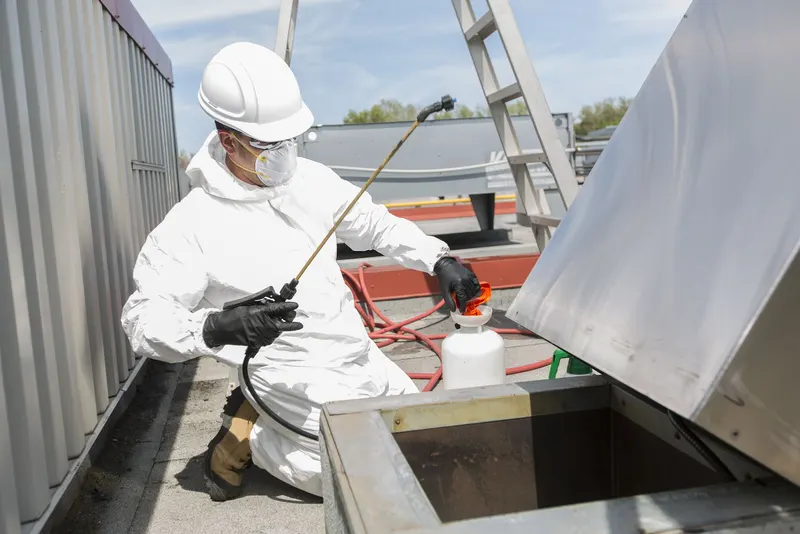
Canopy work is on the hood cleaning services page and the duct run on the kitchen exhaust cleaning page.
Rooftop grease containment in North York: the roof membrane, the landlord and the property manager
Rooftop grease containment is a tray fitted at the fan drain and filled with absorbent media, so condensed grease is caught before it reaches the roof.
Without containment, condensed grease runs down the housing, pools at the curb and soaks into the roof. Grease softens the single-ply membranes on most North York plaza and tower roofs, and a pool of it at the curb is a common cause of a leak above the cook line.
Liability for that damage usually lands on the tenant. A lease makes the restaurant responsible for what its equipment does to the building, so when a landlord's roofer photographs a grease-stained membrane, the repair is billed to the kitchen. A containment unit with its media changed and photographed at every visit is the tenant's evidence of reasonable care.
Exhaust fan repair in North York in 2026: freeze-thaw and roof access on a high-heat kitchen roof
A rooftop fan working through a full freeze-thaw cycle every winter has that cycle shorten its life, and a fan running near capacity on a wok or charbroil line has less margin to begin with.
Cold thickens the grease in the housing and at the drain, so a fan that drained clean in October drains badly by January. Water gets into the cracks that grease opened in the flashing and freezes, and wind off an open plaza roof works the curb fasteners. A high-volume fan on a North York roof is inspected in the fall, before the first freeze, and again after the thaw.
Roof access on a condo or office tower almost always runs through building management rather than the kitchen tenant, so a crew books a window with the property manager before the visit, and a mall food court adds the same step with the landlord's operations office. Coverage is on the areas served page.
Best exhaust fan installation in North York for a new cooking line
Exhaust fan installation is sized from the hood and the appliances under it, not from the fan the last tenant left on the roof.
Too small a fan leaves smoke on the line. Too large pulls heated or cooled air out of the dining room. North York Hood Cleaning sets the fan on a new or existing curb, wires it, and fits the hinge kit and containment on the same visit. The usual case is a Korean barbecue or wok line going into a unit that has never run high-heat equipment, which puts the system on a quarterly or monthly inspection interval. The intervals are on the NFPA 96 page.
How much does exhaust fan repair cost in North York in 2026?
Exhaust fan repair, replacement, hinge kits and rooftop grease containment in North York are quoted per job after inspection or walk-through, with the written quote within 24 hours. For context, a scheduled hood cleaning visit starts from $585 per visit for a single-hood kitchen up to ten feet and from $995 per visit for a multi-hood kitchen of two to four canopies, and fan work is itemised on the same quote.
The price moves with fan size, drive type and the state of the curb. A new curb involves a roofing contractor, itemised on its own line. All three services are on the services page and the kitchen types on the who we serve page.
Next step: call 647-797-9137 or request a written quote. A photograph of the fan on its curb identifies the drive type and the hinge kit that fits it.
Exhaust fan repair in North York: frequently asked questions
What happens if the rooftop fan stops during service?
A cooking line with no working exhaust fan has no capture at the hood, so smoke and grease vapour spread through the kitchen. A stopped fan is an urgent call.
Who pays for rooftop fan repair in a tower or plaza unit, the restaurant or the landlord?
The lease decides. A typical North York plaza or tower lease puts the fan with the tenant and the roof membrane with the landlord.
Can an exhaust fan hinge kit be fitted to an older fan?
An exhaust fan hinge kit fits most rooftop upblast fans, including older units, as long as the base flange and the curb are sound. The base is measured before the kit is ordered.
Does a replacement exhaust fan have to match the old one?
A replacement exhaust fan has to match the airflow the hood needs and the curb it sits on, not the brand of the old unit.
Is rooftop grease containment fitted on a separate visit?
Rooftop grease containment and hinge kits are normally fitted during a scheduled cleaning visit, because the crew is already on the roof.